Live Roulette Australia with English-Speaking Dealers
 Available in US
Explore the legal position, table mechanics, dealer experience, bonuses, odds and risks behind offshore live roulette play.
- What Australian Law Actually Allows in Online Casino Play
- The Live Casino Ecosystem: Studios, Dealers, and the Games on Screen
- Casino Roulette as a Game of Design, Pace, and Chance
- How to Read a Live Roulette Round Without Guessing
- Bonuses, Deposits, and the Fine Print Behind “Free” Play
- Finding Better Roulette Odds Without Calling Them a Winning Edge
- The Wheel, the Dealer, and the Australian Preference for English Tables
- Inside the Roulette Table: Layout, Bets, and the Casino Advantage
- Roulette Strategy and the Seduction of Control
- Playing for Real Money: Offshore Risk Beyond the Spin
What Australian Law Actually Allows in Online Casino Play
Australia’s position on online casino gambling is often described as a simple prohibition. It is more precise than that. The law is directed primarily at the provider: Australian businesses are not permitted to offer online casino games to residents, while the individual player occupies a different legal position.
That distinction matters when considering an offshore live roulette casino online. A person in Australia may encounter a foreign-operated platform offering roulette through a streamed table, yet that does not mean the service is authorised in Australia. The table may be available; the Australian casino licence is not.
A federal restriction on online casinos
The central federal measure is the Interactive Gambling Act 2001. It restricts Australian-based operators from providing real-money interactive casino games to people in Australia. Online roulette, blackjack, pokies and live dealer tables fall within the category of prohibited interactive gambling services when offered to an Australian customer.
This creates a deliberate asymmetry. Online sports betting is legal when supplied by appropriately licensed operators at the state and territory level, while online casino games are prohibited. The same national market therefore treats a wager on a sporting event differently from a wager placed on an online roulette casino. The distinction is regulatory, not technological: both may appear on a screen, but the law does not place them in the same box.
This selection helps Australian players review casino options for live roulette with English-speaking dealers in 2026. Use each short verdict to focus on the operator’s stated licensing, promotions, payment details, and entry requirements.
License: Curacao eGaming Licence · Min. deposit: A$10 Rocket Play is listed with a Curacao eGaming Licence and a low A$10 minimum deposit.
License: Tobique Gaming Commission · Bonus: up to A$8,000 + 400 free spins across 4 deposits · Payout speed: crypto ~10-15 minutes, fiat 1-5 days · Min. deposit: A$30 SkyCrown stands out for a bonus of up to A$8,000 plus 400 free spins across four deposits. Crypto payouts are stated at around 10–15 minutes, while fiat payouts take 1–5 days; the minimum deposit is A$30.
License: Curacao eGaming Licence · Min. deposit: A$10 PlayWest operates under a Curacao eGaming Licence and accepts deposits from A$10.
License: Curacao eGaming (Dama N.V.) · Bonus: up to A$10,000 + 180 free spins, 40x wagering JeetCity Casino is associated with Curacao eGaming through Dama N.V. Its offer includes up to A$10,000 plus 180 free spins with 40x wagering.
License: Curacao, operated by Dama N.V. · Bonus: 325% up to 5.25 BTC + 250 free spins across 4 deposits 7Bit Casino is operated by Dama N.V. under a Curacao licence and advertises 325% up to 5.25 BTC plus 250 free spins across four deposits.
License: international iGaming licence – jurisdiction not named in the source · Bonus: 100% up to A$1,000 + 100 free spins, 35x wagering · Payout speed: PayID 1-24 hours · Min. deposit: A$30 (PayID from A$10) House of Pokies lists an international iGaming licence, with the jurisdiction not named in the source. It offers 100% up to A$1,000 plus 100 free spins with 35x wagering, while PayID payouts are stated at 1–24 hours.
License: Curacao · Bonus: 100% up to A$500 + 200 free spins, 10x wagering · Payout speed: crypto 30-60 minutes, fiat 1-5 days · Min. deposit: A$10 Wild Tokyo is listed with a Curacao licence and offers 100% up to A$500 plus 200 free spins with 10x wagering. Crypto payouts are stated at 30–60 minutes, fiat payouts at 1–5 days, and the minimum deposit is A$10.
Bonus: up to A$750 + 50 jackpot spins, 35x wagering · Payout speed: crypto ~90 minutes, fiat 1-5 days · Min. deposit: A$30 Kingmaker features a bonus of up to A$750 plus 50 jackpot spins with 35x wagering. Crypto payouts are stated at around 90 minutes, fiat payouts at 1–5 days, and the minimum deposit is A$30.
Bonus: up to A$6,600 + up to 250 free spins across 4 deposits DragonSlots Casino is notable for a bonus of up to A$6,600 plus up to 250 free spins across four deposits.
License: Curacao · Bonus: up to A$10,000 multi-stage + 500 free spins · Min. deposit: A$20 (POLi) Lucky Dreams offers up to A$10,000 in a multi-stage bonus plus 500 free spins. The minimum deposit is A$20 when using POLi.
No domestically licensed real-money online casino exists for Australian players. Australian operators are not allowed to offer casino roulette online, live roulette or other online casino products to residents. There is consequently no Australian casino licence that an online casino with roulette could hold legitimately. A platform describing itself as “Australian licensed” for online casino play would be making a claim that deserves considerable suspicion.
The provider–player distinction
The Interactive Gambling Act targets the provider rather than the player. Australians are not committing a crime merely by placing bets at offshore sites. That does not transform an offshore roulette casino online into a locally approved service, nor does it provide the protections associated with a domestic licence.
The difference is easy to miss because the user experience looks complete. A roulette casino online may accept a registration from an Australian resident, show a live table and process a wager. None of those features changes the legal position of the operator. Availability is not authorisation.
This is the point at which casual language causes trouble. Saying that online roulette casinos are “legal in Australia” collapses two separate questions into one:
- Is the individual player prohibited from using an offshore platform?
- Is the provider allowed to supply online casino games to Australian residents?
The first answer is different from the second. The Act does not prohibit individual Australians from playing on offshore platforms, while Australian law does prohibit local operators from offering online casino games to residents.
Why offshore operation changes the picture
Live casino games accessible from Australia are operated by offshore platforms licensed in jurisdictions such as Malta, Curaçao or Gibraltar. Those licences belong to foreign regulatory systems, not to Australia. They may establish that an operator is subject to rules in another jurisdiction, but they do not amount to permission under Australian law to provide an online casino australia roulette service.
This is not a technical footnote. Foreign licensing also means that the legal relationship is formed outside the domestic gambling framework. An offshore platform may display a foreign licence and still provide no Australian consumer protection. Local dispute routes, domestic supervisory arrangements and Australian gambling safeguards should not be assumed simply because a roulette table is available in English or accepts Australian players.
The absence of a local casino licence is therefore not a gap waiting to be filled by a clever search. It is a consequence of the legislative model. Casino games are prohibited for Australian operators, so there is no Australian register of licensed online roulette casinos to consult. The Australian Communications and Media Authority publishes a register of Australian-licensed interactive wagering service providers, but that register concerns permitted wagering services, not domestically licensed online casino games.
What “allowed” means in practice
For an Australian considering live online roulette, “allowed” has a narrow and rather unglamorous meaning. The player is not committing a criminal offence simply by making a wager on an offshore platform. The provider, however, is not operating under an Australian casino licence, because no such licence exists for this product.
That framework should be kept separate from questions about the table, the dealer or the quality of a stream. Those are matters for later evaluation. The legal foundation comes first: an offshore platform may be licensed abroad, but it is not locally licensed to offer online casino roulette in Australia.
Legal Status Australian businesses are prohibited from offering online casino games to residents. While individual players may access offshore platforms, these services are not authorised in Australia.
The arrangement is therefore neither a domestic legal casino market nor a blanket criminal ban on individual players. It is a provider-focused prohibition with an offshore space around it. Neat enough for legislation. Less neat for anyone trying to understand what protection remains when the wheel is hosted elsewhere.
18+ only. Gambling involves risk. Live dealer games should be approached responsibly. Gambling Help Online is available for support. BetStop does not cover offshore casinos and cannot be used to self-exclude from them.
The Live Casino Ecosystem: Studios, Dealers, and the Games on Screen
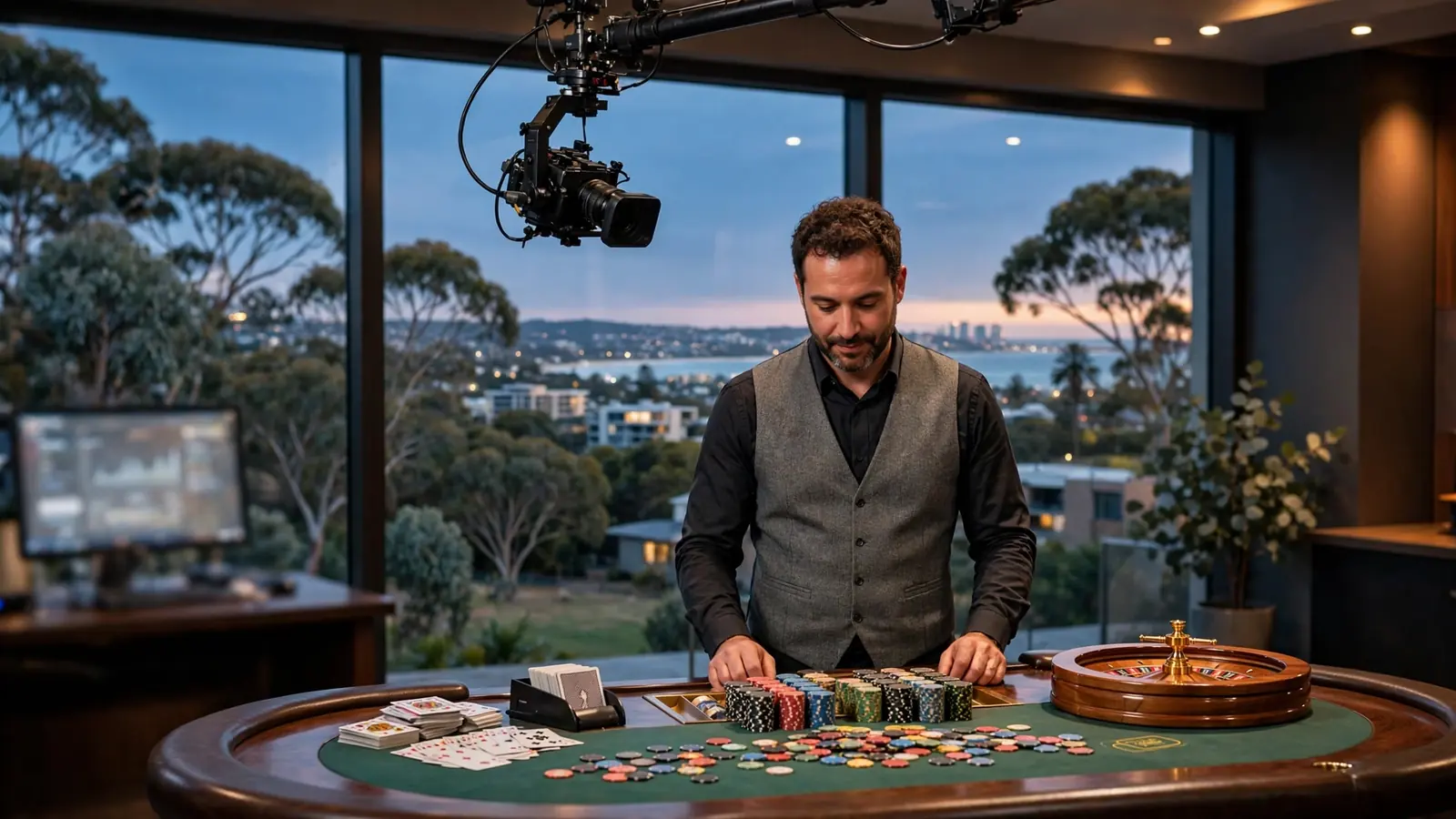
A live casino is less like a traditional roulette casino than a small broadcast operation attached to a gambling platform. The table exists in a studio, the dealer works in front of cameras, and the player joins through a video stream rather than through a purely animated interface. The result is a hybrid space: part casino floor, part television set, part chat room.
For Australian players, these tables are generally supplied by offshore platforms and specialist game studios. The names visible behind the interface may include Evolution Gaming, Pragmatic Play, Ezugi, and VIVO. They are not casinos in the ordinary sense. They provide the streamed games, dealers, cameras, tables, and software that an operator places inside its own website.
That distinction matters. A casino platform may display several studios at once, while the same provider can appear across many different operators. The branding changes; the room often does not.
What the camera changes
A live dealer table uses physical equipment: cards, wheels, chips, betting layouts, overhead cameras, and studio lighting. The dealer’s hands are visible, the action is streamed in real time, and the interface records the available game information beside the video. This is designed to answer an old anxiety of gambling: whether the unseen mechanism is doing what it claims. Visibility becomes part of the product.
The dealer remains the central figure. In a roulette table, the dealer manages the wheel and announces the stages of the round. In a baccarat table, a professional dealer handles the physical cards while the software presents the betting interface and game data. The human presence makes the session feel social even when the underlying arrangement is highly controlled.
It is still not a face-to-face conversation. Players can interact with the dealer and with other participants through text chat, but dealers cannot hear or see the players. The relationship is therefore carefully one-way: the dealer performs, explains, and acknowledges messages, while the audience remains behind the glass of the screen.
A casino, with a comment box.
The games sharing the same room
The live-casino catalogue usually brings several formats together:
- Live Roulette, including tables built around a streamed physical wheel;
- Live Blackjack, where the dealer manages cards and player decisions through the interface;
- Live dealer baccarat, played with physical cards in a studio setting;
- Lightning Baccarat, a baccarat variant presented with an additional game-show style layer;
- No Commission Baccarat, which changes the treatment of selected Banker wins;
- Crazy Time, a wheel-based live game with a presenter and bonus features;
- Monopoly Live, another presenter-led game built around a physical wheel;
- 3D Baccarat by Iron Dog, a baccarat product presented through a digital format;
- VIP NC Baccarat by ICONIC21, a higher-profile baccarat table format.

These games do not all ask the same thing of the viewer. Roulette and baccarat are relatively quiet, dealer-led experiences. Crazy Time and Monopoly Live are built for spectacle, with presenters, graphics, and bonus segments competing for attention. Blackjack sits between the two: the dealer is visible, but the player’s decisions occupy more of the interface.
That variety explains why searches for the best online roulette casinos often lead to pages offering much more than roulette. The operator is selling access to a live environment, not merely a single table. A player may arrive for casino roulette and find baccarat, blackjack, and wheel games presented in the same lobby.
Baccarat as a continuous broadcast
Live baccarat is available around the clock on most Australian online casinos. Its appeal is partly its regularity. A standard table deals 40–50 hands per hour, creating a measured rhythm in which the dealer, cards, and interface repeat a familiar sequence. Speed Baccarat moves at a faster pace, dealing over 80 hands per hour.
Streamed physical wheels and dealers providing a real-time hybrid experience.
Dealer-managed card games with digital betting interfaces.
Professional dealer-led sessions with physical cards in a studio setting.
Spectacle-based formats like Crazy Time or Monopoly Live.
The physical cards are dealt in the studio and shown through webcam video. The platform overlays the relevant information: the current hand, betting options, results, and chat. The basic game logic remains visible without requiring the player to watch every movement with the suspicion of a detective in a low-budget film.
Baccarat also shows how live games combine ritual with automation. The dealer performs the visible actions, while the software manages the timing of betting, closes the table, records the result, and displays the next opportunity. The camera supplies authenticity; the interface supplies order.
The mathematical language sits quietly behind that presentation. In standard baccarat, the house edge is 1.06% on Banker bets and 1.24% on Player bets. Those figures describe the game’s probability, not the quality of the studio or the charm of the dealer. A polished broadcast cannot alter them.
Mobile tables and changing attention
Live baccarat games can be played on mobile devices through a web browser without requiring an app download. The same general model applies to mobile roulette and other streamed tables: the screen becomes smaller, while the dealer’s role remains the same.
Mobile play changes the social atmosphere. On a desktop, the table can resemble a dedicated viewing space. On a phone, it may sit beside messages, travel, work, or an afternoon queue. The live casino has followed the player into ordinary life, which is convenient in the narrow technical sense and revealing in the broader social one.
The chat function adds another layer. Players may comment, celebrate, or complain together, but the conversation does not make the table collective in any meaningful decision-making sense. Each participant remains responsible for their own choices, while the shared stream creates the impression of a room full of company.
This is the enduring trick of the live casino: it turns a solitary transaction into a public performance. The dealer supplies continuity, the studio supplies visibility, and the platform supplies the crowd. The wheel, cards, and table remain familiar. The screen changes the social story around them.
All live casino play is for adults aged 18 and over. Responsible gambling information and support should be easy to find, and any self-exclusion arrangement should take effect immediately. BetStop does not cover offshore casinos and cannot be used to exclude a person from them.
Casino Roulette as a Game of Design, Pace, and Chance
Roulette is a casino game built around a simple spectacle: a wheel turns, a ball travels in the opposite direction, and a room briefly agrees to watch chance become visible. Its appeal is not only the possibility of a payout. The game has a particular theatre, one that survives even when the table is streamed through a screen.
Visual Design Roulette tables use a legible design where colours and physical movements establish a clear, rhythmic pace for the player.
The design is deliberately legible. Colours divide the numbered field, the wheel gives the result a physical home, and the dealer’s gestures establish a rhythm that needs little explanation. Roulette does not hide its central event behind complicated machinery. Everything points towards the pocket where the ball settles. Then the table resets, as if uncertainty could be tidied away with a rake.
That clarity gives the roulette casino game a character unlike many other casino games. A card table depends on hands, totals, and decisions made through a sequence. A pokie compresses its mechanics into symbols and sound. Roulette leaves the decisive movement exposed. The wheel performs the uncertainty rather than merely reporting it.
The live table as a social scene
A live roulette table adds human presence without making the game collaborative. The dealer spins the wheel, manages the table, and announces the stages of the round. Other participants appear through chat or table indicators, sometimes as names, sometimes only as a cluster of wagers. Their presence changes the atmosphere, even though each result remains independent of the audience’s mood.
This is part of what makes live roulette feel different from a purely digital version. The dealer supplies continuity. There is a pause before the spin, a moment when late movement stops, and a small collective attention around the wheel. The pace is neither entirely leisurely nor aggressively fast. It is a repeated ceremony.
English-speaking dealers matter here for more than translation. Clear announcements make the table easier to follow, while informal remarks give the stream a social texture. The dealer cannot hear or see the players, but the table still creates the impression of a shared room. A modest illusion, carefully engineered.
The experience also depends on pace. Some tables feel almost conversational, leaving time to watch the wheel and the dealer’s handling of the round. Others are arranged for quicker repetition, making the game feel closer to a continuous sequence than a single event. Neither pace changes the underlying chance. It changes only how much time and attention the player gives to each result.

One game, several visual personalities
The familiar red-and-black wheel is the cultural image of roulette, but live casino roulette may be presented in different formats. A standard table emphasises the real wheel and dealer. A studio table may use a polished set, fixed camera angles, and a more formal presentation. A mobile stream reduces the scene to a compact window, where the wheel competes with the practical limits of a phone screen.
An American roulette casino table has a distinctive visual identity because its wheel includes both zero and double zero. That extra pocket is not decorative. It is part of the game’s mathematical design and gives the format a different relationship with chance than a single-zero wheel. The table may look familiar, but a small detail changes the structure beneath the felt.
A roulette casino app, meanwhile, is less a separate game than a different doorway into the same spectacle. On a browser-based mobile interface, the wheel, table, dealer video, and chat must share limited space. The result can feel intimate or cramped, depending on the design. The wheel remains the star, but the screen decides how much of the theatre survives.
Roulette’s endurance comes from this balance between order and randomness. The layout is fixed, the ritual is recognisable, and the outcome refuses to be persuaded. That tension is the game’s real design: a highly organised stage for an event no participant controls.
How to Read a Live Roulette Round Without Guessing
The easiest way to understand casino roulette is to follow its order rather than search for a secret inside it. A live table is a small public ceremony: the dealer opens betting, the wheel begins its work, the betting window closes, and the result is announced. Nothing needs to be predicted for the sequence to make sense.
Round Sequence
The dealer opens the betting window and the table becomes active.
Players select chip values and place them on the designated areas of the layout.
The dealer announces that betting is closed, and no further wagers can be added.
The dealer releases the ball and the wheel is set in motion.
The ball settles in a pocket, the dealer identifies the number, and winnings are settled.
Before the spin
A live roulette screen normally shows the wheel, the dealer, the betting layout and a status indicator for the current round. The layout is where wagers are selected. A player chooses a chip value, places chips on the relevant areas, and watches the table until the dealer closes betting.
This is the practical answer to how to play roulette at a casino for beginners: identify the table, choose the stake, place a bet before betting closes, and wait for the result. The live format adds a human pace to the process. The dealer is not a decorative figure hovering beside a digital wheel; the dealer controls the round and marks each stage aloud or on screen.
The betting window matters. Once the dealer announces that betting is closed, additional chips cannot be added to that spin. Any uncertainty should be resolved before that point, not by trying to force a late decision into the round.
What happens during the round
After betting closes, the dealer releases the ball and the wheel turns. The screen may show the motion from several angles, while the layout remains visible for confirmation. When the ball settles, the dealer identifies the winning number and removes or marks the losing wagers. The winning area is then paid according to the table’s rules before the next betting period opens.
The round is therefore easier to read as a sequence:
- The table opens for bets.
- Chips are placed on the layout.
- Betting closes.
- The wheel and ball are set in motion.
- The ball lands in a numbered pocket.
- The result is confirmed and payments are settled.
- A new round begins.
A beginner does not need to memorise every possible wager before observing a few rounds. The important distinction is between selecting a place on the layout and predicting what the wheel will do. The first is an action; the second is an uncertain judgement. Roulette does not turn the latter into knowledge merely because the table is streamed in high definition.
Reading the live table
Dealer-led play also changes the social texture of the game. Players can communicate with the dealer and other participants through text chat, but the dealer cannot hear or see them. The chat may make the table feel communal, although each wager remains separate. Another player’s dramatic win does not alter the next spin, and a quiet table is not evidence that anything is wrong.
The same basic sequence applies on a mobile device. Live casino games can be accessed through a web browser without an app download, so the table may appear on a smaller screen. That makes clear labels and a visible betting timer especially important. The screen should show which chips are active, whether betting remains open, and which number the dealer has confirmed.
Searching for how to win roulette in a casino often begins with a misunderstanding: that careful observation can convert the dealer’s routine into a forecast. Observation is useful for following the round, not for controlling its outcome. Roulette rewards attention with clarity, not certainty.
Live casino play is for adults aged 18 and over. Gambling can cause harm; responsible-gambling support is available through Gambling Help Online.
Bonuses, Deposits, and the Fine Print Behind “Free” Play
A roulette casino bonus is rarely free in the ordinary sense. It is a contract attached to a deposit, a withdrawal rule, and a wagering calculation that may be less visible than the headline offer. The word bonus does the friendly work. The terms do the accounting.
Bonus Terms Attention Always check if live dealer games are excluded from wagering requirements, as many bonuses contribute 0% towards turnover.
A bonus may be calculated through a multiplier applied to the bonus amount alone. That interpretation comes from a specialist affiliate review, not from a universal market rule. The same review notes that some casinos calculate wagering on both the deposit and the bonus. Those two formulas can produce very different obligations, so the definition of the qualifying amount matters before any play begins.
Published wagering requirements for bonuses are described as ranging from 20x to 30x in the supplied market material. The same material treats 35x as an industry mid-range figure, under 30x as low, and anything above 50x as requiring careful review. These are reference points, not guarantees of fairness. A requirement above 50x is a warning to examine the calculation, eligible games, expiry conditions, and withdrawal rules line by line.
Roulette, live tables, and excluded games
Roulette is not automatically useful for clearing a bonus. Pokies may contribute 100% toward wagering requirements, while blackjack and roulette may contribute 10% or 0%. Live dealer games are frequently excluded altogether. A live casino roulette table can therefore look active on the screen while contributing nothing to the required turnover.
Live baccarat contributions are also inconsistent. One specialist review places them between 5% and 15%, while another describes baccarat contributions between 5% and 10%. A further operator-specific comparison reports that KingMaker live dealer baccarat contributes 0%, whereas its RNG baccarat contributes 10%; other material gives a conflicting version of that comparison. The disagreement is precisely why the game contribution table attached to the individual offer matters more than a general guide.

Playing an excluded game can void the bonus entirely. Maximum bet limits may apply while wagering requirements are active, and exceeding them can void winnings. The terms may also impose a maximum cashout limit after the wagering requirement has been completed. Finishing the calculation is not necessarily the same as being free to withdraw the full balance.
This makes a roulette casino no-deposit bonus particularly easy to misunderstand. No deposit does not mean no conditions. An online casino roulette no-deposit offer may still restrict eligible games, cap the resulting cashout, limit bet size, or exclude live dealer play. The adjective is doing too much work.
Deposits and payment language
A deposit is not proof that a promotion is suitable for roulette. Payment options such as Bitcoin or another cryptocurrency may attract players looking for a crypto casino roulette table, but the payment method does not alter the bonus contract. A bitcoin roulette casino can still apply the same contribution exclusions, maximum bet rule, and cashout cap as any other offshore platform.
Fast products deserve the same scrutiny. Lightning Roulette live casino tables, sometimes described as live casino Lightning Roulette, add a quicker and more theatrical format, but speed does not soften contractual conditions. The offer may exclude the game or assign it a contribution rate different from standard roulette.
The sensible “tips for roulette in casino” are therefore administrative before they are tactical: record the qualifying amount, check the contribution rate, find the maximum bet, and read the cashout clause. The headline is decoration. The small print is the machine.
18+ only. Gambling involves risk. Live dealer games are frequently excluded from bonus wagering requirements. BetStop does not cover offshore casinos and cannot be used for self-exclusion from them. Responsible-gambling tools should be clearly available and take effect immediately.
Essential Review
- Verify the offshore licence directly with the issuing regulatory authority.
- Confirm the specific game contribution rates for any bonus wagering.
- Check maximum bet limits and cashout caps in the fine print.
- Use responsible gambling tools to manage your play.
Finding Better Roulette Odds Without Calling Them a Winning Edge
“Best” is a slippery word at a roulette table. It may describe the clearest interface, the most suitable pace, a transparent rule set, or simply the game that produces the least unfavourable mathematics. None of these meanings turns roulette into a positive-expectation game. The casino keeps its advantage; the label merely describes how carefully the product has been assembled.
What better odds actually mean
The first distinction is between the odds of an individual bet and the quality of the table itself. Inside bets can offer larger potential returns, while outside bets win more frequently but still carry the casino’s built-in margin. A string of recent colours does not alter that margin, and a live dealer does not become a statistical ally because the table feels more personal.
A sensible comparison of casino roulette bets therefore begins with the rules attached to the wheel:
- whether the table uses a single-zero or a double-zero layout;
- how winning bets are paid;
- whether special rules change the treatment of certain outcomes;
- whether the displayed rules are available before a wager is placed.
These details matter more than a fashionable “best roulette strategy casino” claim. A strategy can organise staking or limit impulsive decisions, but it cannot remove the mathematical disadvantage. Control over the bet is not control over the result.
A practical meaning of “best”
For a player comparing a best live roulette casino, product quality is broader than probability. A useful table should make the betting options legible, show the result clearly, and state its rules without hiding them behind promotional language. Stream quality and dealer presentation affect the experience, but they do not improve the casino roulette odds.
The same discipline applies to claims about the “best odds in casino roulette”. The phrase should be read as a request for the least damaging available conditions, not as evidence of a winning edge. A table may be preferable because its rules are easier to verify or because its pace suits cautious play. That is a product judgement, not a promise of profit.
Probability without superstition
Roulette encourages stories: lucky numbers, overdue colours, systems that supposedly correct a losing sequence. Probability is less theatrical. Each spin is a separate event, and previous outcomes do not create a debt that the wheel must repay.

This is why a best roulette casino should be assessed through disclosed rules and honest presentation rather than through dramatic claims about systems. Even a carefully chosen wager remains exposed to chance and the house edge. “Better” can mean clearer, slower, or mathematically less punitive. It cannot mean guaranteed.
The comparison is almost austere. Read the rules. Separate entertainment from expectation. Keep the word “best” on a short leash.
The Wheel, the Dealer, and the Australian Preference for English Tables
A roulette table becomes more legible when the wheel is treated as a physical object rather than a decorative animation. The ball travels around the outer track, loses speed, and eventually falls into one of the numbered pockets. The croupier’s hand, the wheel’s movement, and the camera angle together create the small theatre that distinguishes live roulette from an entirely digital game.
That theatre matters because the wheel is also a visible promise of procedure. A studio camera shows the spinning mechanism, the dealer’s actions, and the result in real time. It does not turn chance into certainty. It merely makes the process observable.
What the camera adds
A live roulette wheel casino stream usually places the wheel close to the foreground, with the dealer positioned beside it or within the same frame. The physical equipment is central: the ball, the pockets, the rotor, and the dealer’s gestures carry more meaning than a sequence of animated symbols.
English-speaking dealers Professional dealers who provide verbal commentary and announcements in English, enhancing the social texture and clarity of the live stream.
The wheel itself is not a prediction device. Its movement may look familiar from round to round, but appearance does not create a dependable pattern. The attraction is elsewhere—in seeing an event happen rather than receiving an abstract outcome from software.
The dealer gives the broadcast its human rhythm. A spin begins, the ball circles, the table closes for new activity, and the result is announced. These actions make the game feel social even when the participant is sitting alone in Australia, watching a stream hosted from overseas.
Why English changes the experience
For Australians looking for live roulette with English-speaking dealers in 2026, language affects more than courtesy. It determines how easily the table’s announcements, timing, and chat exchanges can be followed. A dealer’s spoken explanation can clarify what is happening on screen without turning the broadcast into a lesson.
Text chat adds another layer. Participants may communicate with the dealer and with one another through the table interface, although dealers cannot hear or see the players. The conversation is therefore selective and public-facing: a written channel beside a one-way video window. Social, but with boundaries.
This is especially useful when a table has a particular pace or presentation style. The English-speaking dealer supplies continuity between rounds, while the physical wheel supplies the visual anchor. Neither changes the mathematics. They change the experience of being present.
Live casino platforms serving Australian customers operate offshore and may hold licences from jurisdictions such as Malta, Curaçao, or Gibraltar, not an Australian casino licence. That distinction sits behind the polished studio image. The camera may look local; the legal and operational setting is not.
Mobile access can make the same streamed format available through a web browser without an app download. A smaller screen reduces the wheel to a compact stage, but the essential arrangement remains: dealer, camera, physical equipment, and chat. The ritual travels well.
18+ only. Gambling can cause harm. Gambling Help Online is available for support. Offshore platforms are not covered by BetStop, and self-exclusion tools may not extend beyond the operator that provides them.
Inside the Roulette Table: Layout, Bets, and the Casino Advantage
A casino roulette table is less mysterious than it looks. Its layout is a compact diagram of probability, payment, and the small advantage reserved for the house. The painted numbers invite selection; the structure quietly records the price of every selection.
At the centre are the individual numbers, arranged in three columns and several rows. These are straight-up bets: a chip placed on one number. Neighbouring spaces create split, street, corner, or line bets, covering progressively larger groups. The outer bands hold the even-money choices—red or black, odd or even, and high or low numbers. They appear reassuringly broad. Broad is not the same as favourable.
The zero sits apart from the numbered field. That solitary green space is the essential design feature in a single-zero roulette table. Red and black divide the numbered outcomes almost evenly, but neither includes zero. The same is true of odd and even, high and low. A winning-looking distribution therefore remains incomplete by one pocket, and that pocket belongs to the casino.
This is the roulette casino advantage in its most visible form. The table does not need to manipulate the wheel or persuade anyone to choose a particular number. It simply offers bets whose payouts are set against a field containing the extra house outcome. Every chip is a small contract with that arrangement.
The House Edge The casino advantage is built into the layout, such as the presence of the single zero in a standard roulette wheel, which ensures the mathematical margin remains in favour of the house.
A roulette casino table also communicates the difference between coverage and payment. A bet covering more numbers wins more frequently than a single-number bet, but its payout is correspondingly smaller. A narrow bet produces longer stretches without a win and a larger payout when the selected outcome appears. Neither changes the underlying ownership of the extra pocket.
The visual language can make this seem more democratic than it is. Rows, colours, symmetry, and neatly separated boxes suggest that every route through the layout is equally sensible. They are not equally frequent, and none removes the casino’s built-in margin. The table is an accounting device dressed as a game board. Very elegant accounting.
Roulette Strategy and the Seduction of Control
Roulette strategy has always offered more than a betting plan. It offers a story about order. A sequence of red results appears, a number has been absent for several spins, and the mind begins arranging accidents into evidence. Casino roulette strategy turns randomness into a character with habits, moods, and supposed weaknesses. The wheel, naturally, has none.
Systems such as doubling after a loss or changing stakes after a run of one colour can feel persuasive because they create visible decisions. A player is no longer merely waiting for an outcome; every spin seems to invite a correction. That sense of agency is psychologically powerful, particularly at a live table where the dealer, wheel, and chat give chance a social setting. It remains a feeling, not a mathematical advantage.
A roulette strategy to win in casino play cannot remove the built-in house edge. Previous results do not make a colour “due”, and a run does not become more likely to continue merely because it has already begun. Pattern recognition is useful in many parts of life. Here, it is often a machine for manufacturing confidence.
The more defensible form of strategy is less glamorous: decide a bankroll before play, set a stopping point, and treat losses as a limit rather than an invitation to recover them immediately. That is not a route to profit. It is a way of preventing one result from dictating the next decision.
Bonuses add another layer of imagined control. A profile review describes wagering requirements ranging from 20x to 30x, while identifying anything above 50x as requiring careful review; the same type of source advises avoiding multipliers above 45x because the probability of profit is low. Those figures describe promotional conditions, not a roulette advantage. They can also distract from exclusions and maximum-bet clauses.
The seduction lies in the word system. It sounds engineered, and engineered things appear to belong to their maker. Roulette belongs to chance. No system changes that.
Playing for Real Money: Offshore Risk Beyond the Spin
Playing casino roulette for real money from Australia means stepping outside the domestic consumer-protection framework. Australian operators are not allowed to offer online casino games, so live tables serving local players are run by offshore platforms. Their licences may come from Malta, Curaçao, or Gibraltar, but that is not an Australian casino licence and does not create local legal recourse.
A licence check still matters. The operator should display a licence number and the issuing authority. That number needs to be checked directly against the relevant regulator’s database, rather than accepted as decorative text on a casino page. An offshore licence may show that a platform is subject to some external oversight; it does not make the service a locally licensed or locally protected option.
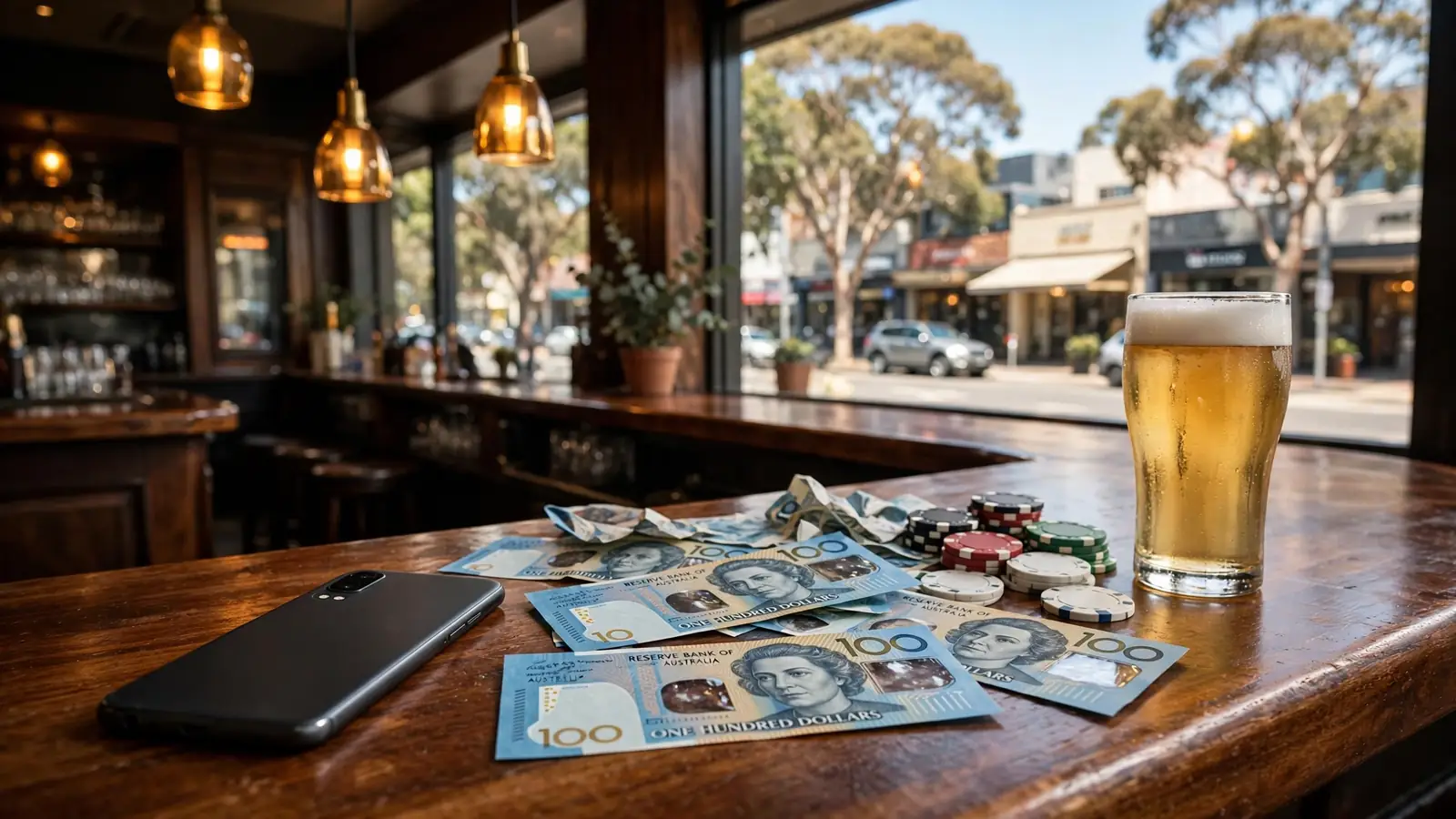
The practical risk extends beyond the spin. Australian consumer protection does not apply in the same way, and disputes may have to be handled through the offshore operator or its foreign regulator. Payment problems, account closures, and contested withdrawals therefore carry consequences that a domestic gambling product would not.
Bonus conditions deserve the same suspicion. Live dealer games are frequently excluded from wagering requirements, and excluded games can void a bonus entirely. Maximum bet limits may apply while requirements are active; exceeding them can void winnings. Terms may also impose a maximum cashout limit after wagering is completed. The headline offer is the least informative part.
Self-exclusion is another hard boundary. BetStop does not cover offshore casinos and cannot be used to exclude an account there. Any responsible-gambling controls must be easy to find and take effect immediately, not after a 24-hour delay. If play no longer feels optional, the sensible action is to stop and contact Gambling Help Online.
18+ only. Gambling involves financial risk; no roulette result can be guaranteed.
Prepared by the Casino Info Au editorial staff.